
Captain Cook Snorkeling Kona Hawaii: What to Know in 2026
Captain Cook Snorkeling Kona Hawaii guide: departure timing, tour options, reef wildlife rules, swimmer safety and what to pack for Kealakekua Bay.
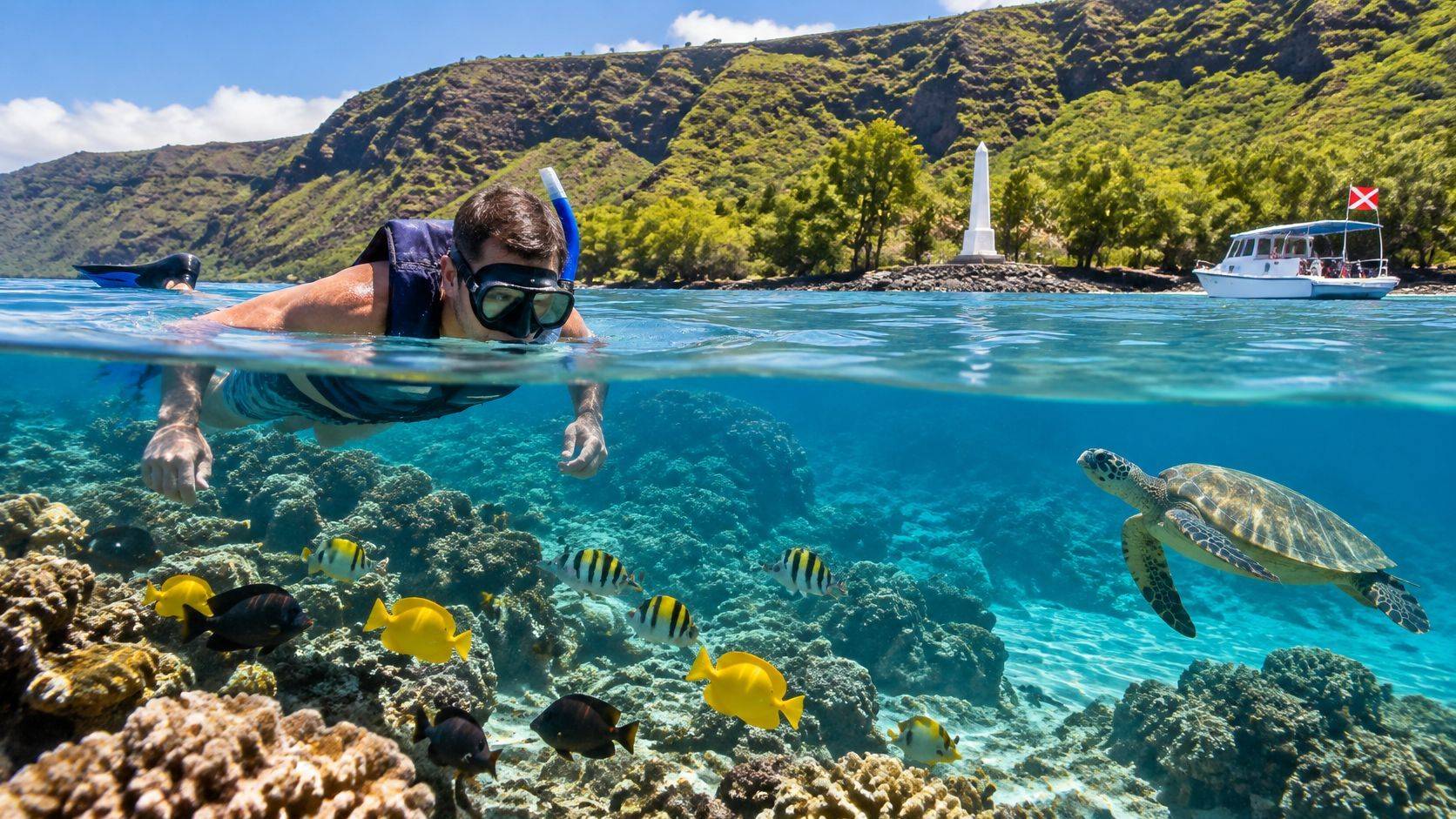
You're looking at photos of bright turquoise water, a white monument, and schools of yellow fish, and you're trying to decide if you're ready for it. That's the right question for Captain Cook snorkeling, Kona, Hawaii. The bay often looks calm from the boat, but calm-looking water doesn't remove risk. A guided trip changes your risk with briefings, flotation, and crew watching the water. It doesn't erase the need for honest swimming ability, good timing, and respect for a protected place.
Choosing a Morning or Afternoon Departure at Kealakekua Bay
At 7 AM in the harbor, you're holding coffee and choosing between two departures. Don't treat that as a calendar problem. It's the decision that changes your water more than any mask or fin you bring.
Hawaii's official ocean safety guidance reports that morning generally offers better ocean conditions, visibility, and marine life activity, and it identifies high surf, strong currents, heavy shorebreak, and shallow breaking waves as adverse snorkeling conditions. Treat departure timing as a safety and water quality variable. I do.
Morning Versus Afternoon Conditions at Kealakekua Bay
Departure window — Water and wind — Visibility and marine life — Best fit
Morning departure — Calmer water and lighter wind — Generally better visibility and more marine life activity — First-time snorkelers, families and nervous swimmers
Afternoon departure — Wind and surf typically build through the day — Visibility can drop as conditions churn — Confident swimmers who accept changing conditions
Practical rule: First-time snorkelers, families with young children, and anyone nervous in open water should book the earliest departure.
Conditions can still change through the day. Wind builds, chop gets on your face, and breathing through a snorkel gets harder even if the reef below still looks clear. The captain makes the final call on whether it's safe to enter, and you need to accept a turnaround or cancellation if the bay is rough.
Before you book, check three things. Look at the forecast for wind and swell, confirm the exact departure window you're buying, and decide now that you'll accept the captain's no-go call. If you're mapping other water transport around your stay, Lodging Nearby's water taxi guide helps you avoid building a tight transfer into a morning check-in.
Don't pick afternoon because you want to sleep in if you're already unsure about swimming. Read the timing trade-offs in our guide to when the best snorkeling conditions occur in Hawaii, then choose the window your ability can handle.
How the Captain Cook Snorkel Trip Runs, Step by Step
A good trip feels orderly because each stage solves a problem before it reaches the water. Here's how ours runs.
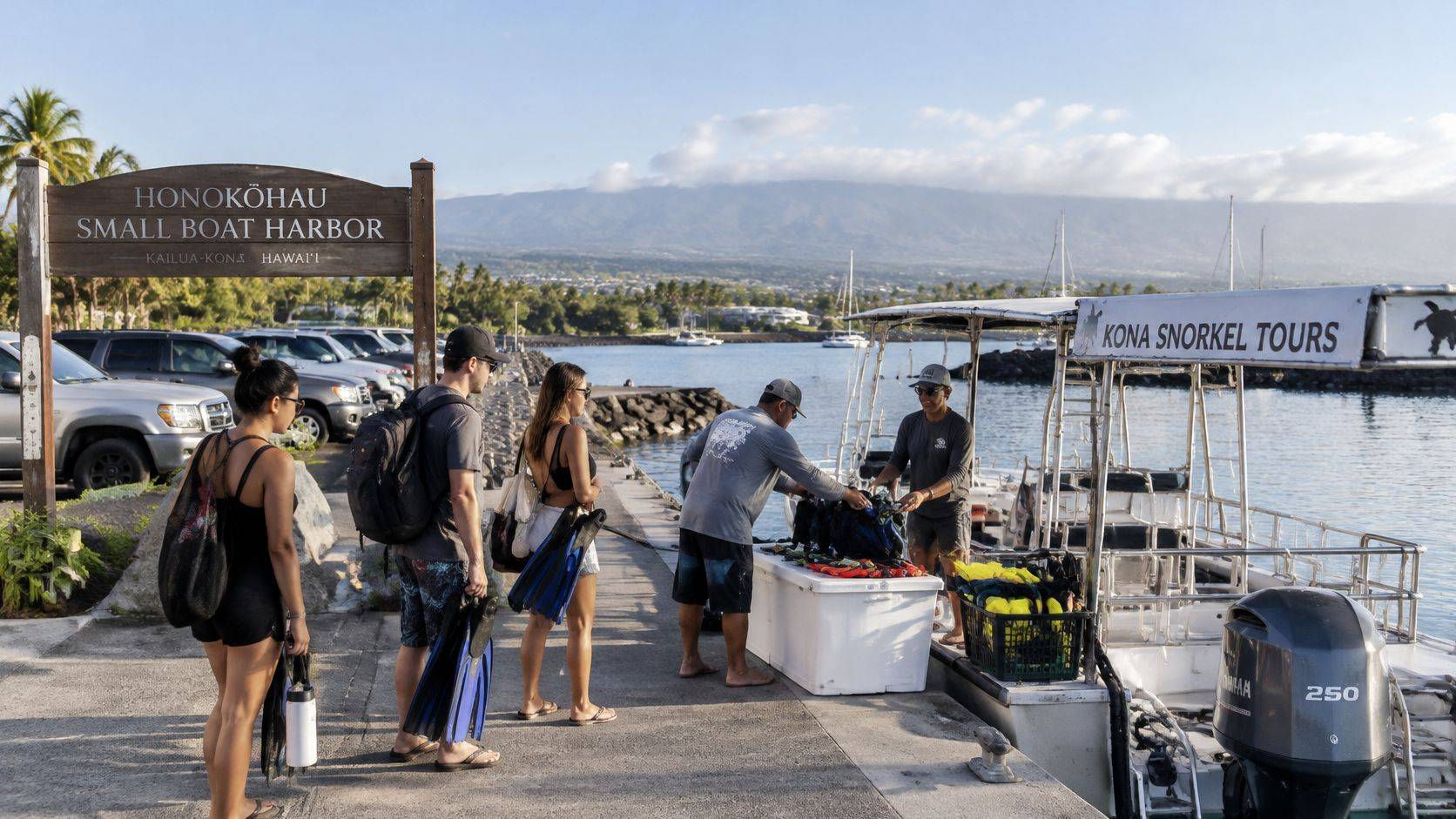
- Arrive at Honokōhau Small Boat Harbor in Kailua-Kona. Boat check-in is there, parking is free, and we don't run hotel pickups, so plan your drive. Arrive late and you compress gear fitting, which is where avoidable mask leaks start.
- Check in and listen to the safety briefing. We cover buddy pairing, flotation support, mask clearing, and the signal to return to the boat. You need those signals in your head before excitement and splashing make hearing harder.
- Board and ride south along the lava coastline. The route from Honokōhau Harbor to Kealakekua Bay and back covers 15 miles of lava coastline each way. The South Kona leg takes about 1 hour, with the boat easing off for history stops along the shoreline. Use that ride to settle your breathing, check your mask strap, and tell the crew early if you feel seasick or nervous.
- Tie up off the Captain Cook Monument. The boat anchors in calm, protected water off the white obelisk of the Captain Cook Monument, and the crew deploys the diver flag. The Hawaii Division of Boating and Ocean Recreation snorkeling and diving rules require a red-and-white diver flag whenever snorkeling is in progress in navigable waters, and snorkelers in ocean waters must surface within 100 feet of the flag, except during an emergency. That flag warns other vessels that people are in the water. Drifting beyond it is the common slip I won't tolerate.
- Snorkel for about one hour in the water. Guides handle the gear, point out reef life, and share Captain Cook's story while you float. Slow down, keep your body flat, and scan ahead instead of kicking hard over the coral.
- Return when the crew calls you back aboard. Don't chase one last fish photo. A clean, unhurried recall keeps the group together and gets tired swimmers up the ladder while help is right there.
Why Kealakekua Bay Is Both Historic and Protected
Say you float up, look at the cliffs and the monument, and ask why boats don't just land everyone on shore. The answer is history and law, not inconvenience for its own sake.
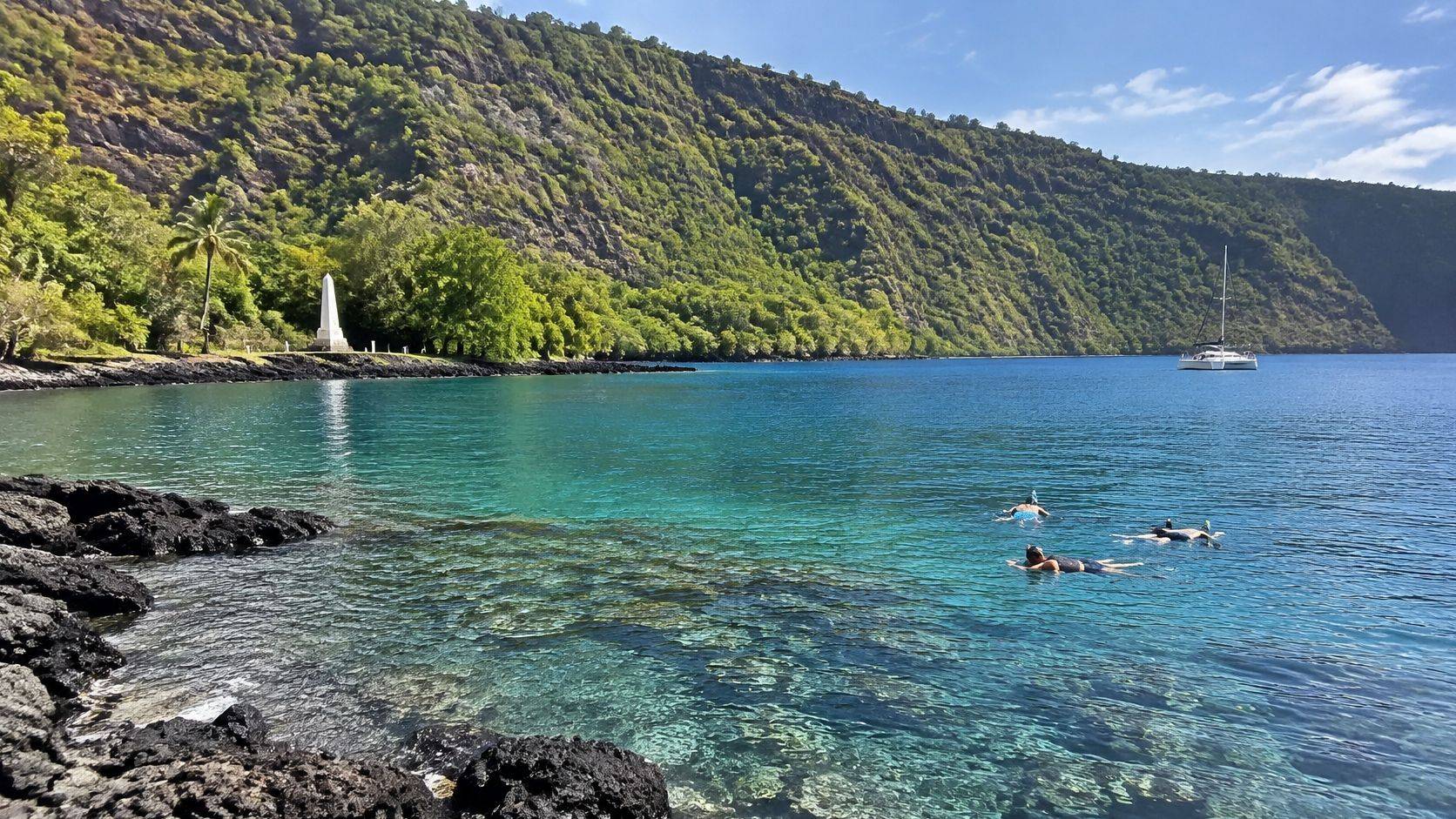
The Hawaii Division of Aquatic Resources page for Kealakekua Bay states that Captain James Cook arrived at Kealakekua Bay in January 1779 during his second voyage to the Hawaiian Islands and initially received what the state describes as royal treatment. The following month, Cook was killed at Ka'awaloa Cove during a conflict involving his crew and local Hawaiians. A 27-foot monument was erected near the location in 1878.
Tell that story plainly. The bay was an important Hawaiian place before Cook arrived, and the monument marks a violent encounter, not a simple discovery celebration. When you understand that, you stop treating the shoreline as scenery for a landing photo.
What Protection Means in Practice
That same state page states that the Kealakekua Bay Marine Life Conservation District covers 315 acres and was established in 1969, with northern Subzone A and southern Subzone B. It's on Hawaii Island's western coast near the village of Captain Cook, approximately 30 minutes south of Kailua-Kona. The district creates rules for fishing, boating, anchoring, and mooring that protect the reef you're coming to see.
Reaching the monument and snorkel spot by land requires a multi-mile hike down a steep trail with no facilities, which the boat avoids. That isn't a sales point. It's an energy decision, because arriving hot and drained makes your snorkel worse and your climb back harder.
Read our explainer on why Kealakekua Bay carries protected status before you go. Access limits and no-landing expectations are stewardship for a cultural landmark and regulated reef. Follow them without arguing with the crew.
Reef Wildlife, Dolphin Encounters and Ethics
You'll see the reef in layers if you stop charging across it. Parrotfish, butterflyfish, and tangs feed over coral shelves near the anchor area, schools drift past the boat, and Hawaiian green sea turtles work reef edges and grazing areas. Float flat, breathe slowly, and let fish resume what they were doing before you arrived.
Don't touch coral to steady yourself. Coral is living habitat, and fins, knees, and hands break it and stir sediment over it. If you're tired, roll onto your back, rest with your flotation, and signal your buddy.
Where to Look for Reef Wildlife and How to Behave
Species — Where you usually see it — What to do
Spinner dolphins — Open water and resting areas in the bay — Keep 50 yards away; never pursue or encircle
Parrotfish, butterflyfish and tangs — Over the coral shelves near the boat anchor area — Look only; do not touch or feed
Hawaiian green sea turtles — Reef edges and grazing areas — Give generous space; never touch or ride
The Hawaii Division of Aquatic Resources rules for the Kealakekua Bay MLCD prohibit fishing for, taking, or injuring marine life in the district, except for specifically listed activities in Subzone B. Those rules also prohibit removing or altering sand, coral, geological features, or specimens, and prohibit feeding or attempting to feed fish. Snorkeling here is observational. Don't collect shells, don't stand on coral, and don't use an animal as a resting surface.
Feeding fish changes their behavior and pulls animals toward boats and hands. Touching wildlife stresses it and can injure you. Your photo isn't worth either outcome.
If Dolphins Appear
Sightings are never guaranteed, and I won't promise them to sell you a seat. A Hawaii DLNR planning document for Kealakekua Bay describes the bay as a Marine Life Conservation District, recommends permitting watercraft to control launchings, landings, and visitor numbers, and notes that NOAA Fisheries prohibits approaching or remaining within 50 yards of Hawaiian spinner dolphins.
If a pod appears, stay calm and keep your distance. Don't swim toward resting animals, don't cut off their path, and never encircle them for a closer photograph. The captain may move the boat or end the encounter, and that's the correct call even if you're disappointed.
Our guide to swimming near dolphins in Hawaii ethically gives the behavior standard in plain language. Dolphins resting in the bay need quiet water during the day. Your job is to leave them that quiet.
Float, look, and let the animals set the distance.
Access rules follow the same logic. Managed watercraft, controlled landings, and visitor limits protect a reef and a Hawaiian cultural site from being loved to death. Treat restrictions as stewardship, not as a challenge to work around. The best wildlife moment is the one the animal chooses, at a distance that doesn't change what it was doing.
Checking Whether Your Swimming Ability Fits the Bay
Calm-looking water does not remove risk. That's the sentence to remember before you book Captain Cook snorkeling in Kona, Hawaii.
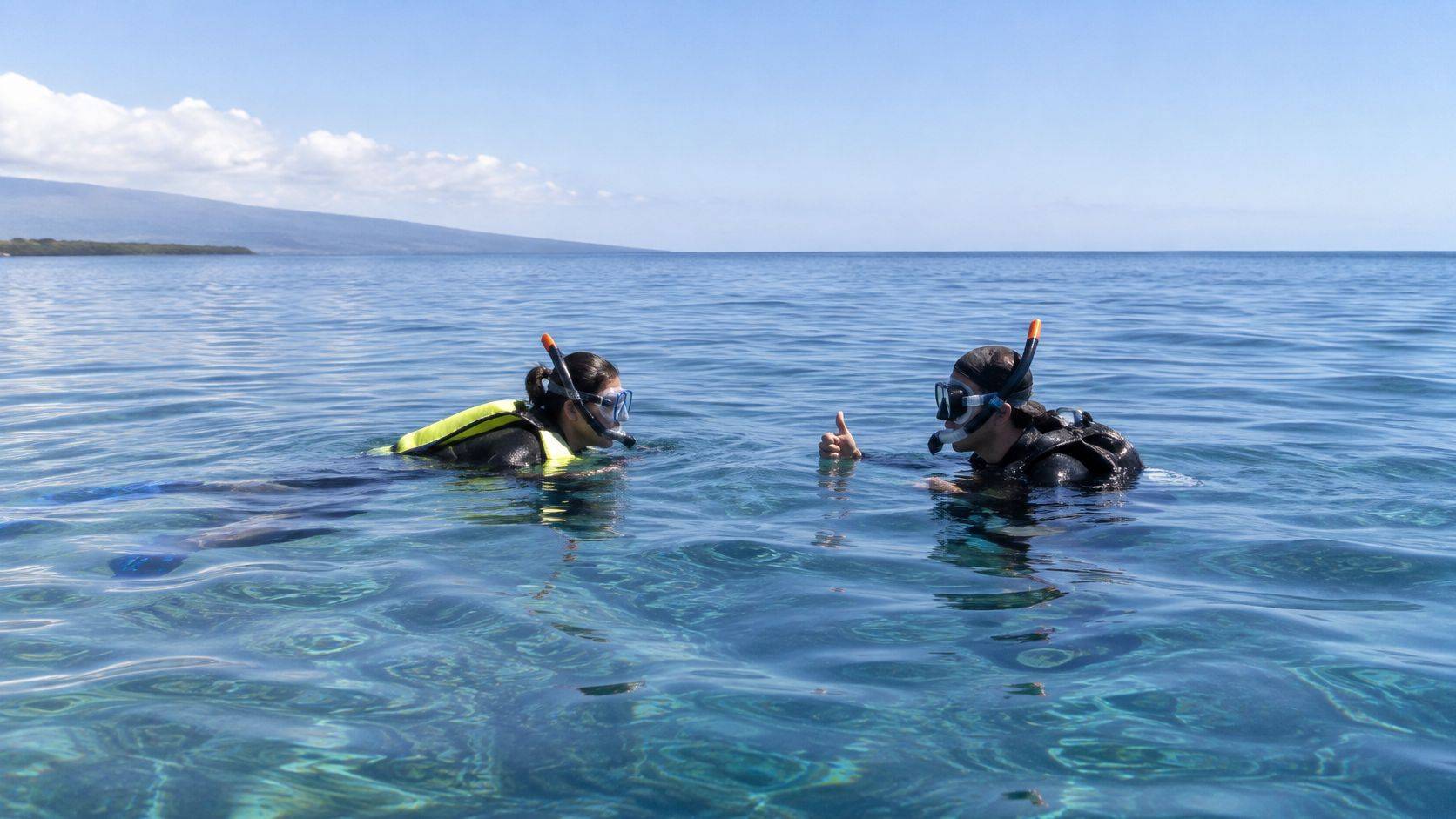
The Big Island snorkel safety guide on Ocean Safety reports that snorkeling is Hawaii's leading ocean-drowning activity for visitors, with 225 snorkeling-related ocean drowning deaths from 2014 to 2023, including 205 visitors. It also identifies Kealakekua Bay in Hawaii's 2025 Water Safety Plan as one of Hawaii Island's drowning black spots. I'm not citing that to scare you. I'm citing it so you screen yourself carefully.
A guided boat changes the setup. Our guides are lifeguard-certified, we brief you, we hand out flotation, and we watch conditions. None of that lets a nonswimmer safely pretend this is a pool float.
Answer These Questions Honestly
- Deep water comfort: Can you swim comfortably in deep open water without standing up when you get tired?
- Resting ability: Can you rest while floating with a flotation noodle or vest and breathe calmly?
- Medical limits: Do you have a heart, lung, back, or neck condition that cold shock, exertion, or a ladder climb could aggravate?
- Recent strain: Have you had recent surgery or a long-haul flight that leaves you dehydrated, swollen, or exhausted?
If you answered no to the first two, don't book the in-water portion until you've built basic swim skill. Children need direct adult supervision and a fit that keeps the mask sealed without constant fussing. Older adults should weigh ladder entry, boat motion, and stamina, not just enthusiasm. Weak swimmers should tell us at check-in, use flotation from the start, and stay close to the boat.
Staying aboard is a valid choice. Forcing an entry to avoid embarrassment is how manageable nerves become an emergency.
In the water, stay with your buddy within sight, keep visual contact with the boat, and clear your snorkel with a sharp exhale before you lift your head and thrash. If you inhale water, stop kicking hard, roll to rest on your flotation, cough, signal your buddy, and head back if breathing doesn't settle fast. Anyone comparing a daytime reef swim with a night float should also explore Kona manta ray snorkeling with the same honesty about comfort in open water after dark.
Ask us before booking about boarding from the harbor, ladder entry and exit, seating on board, and staying aboard without entering the water. Guests who use a wheelchair or have mobility limits should contact us before arriving so we can plan boarding and seating. Don't assume the boat is wheelchair accessible.
Follow the guide's call on the day. If wind, current, visibility, or your own breathing says no, stay on board and enjoy the coast from the deck.
What to Bring and How to Prepare for the Boat
Pack light, pack the night before, and bring items that solve sun, motion, and wet gear problems.
- Reef-safe sunscreen: Apply it about 30 minutes before boarding so you're not greasy while handling gear.
- Rash guard or thin wetsuit top: Use it for sun coverage and wind chill on the ride back.
- Towel and change of clothes: Wear swimwear under your clothes and bring dry layers for the harbor drive.
- Dry bag: Keep your phone, keys, and wallet in one sealed place, and leave other valuables at the hotel.
- Refillable water bottle: Hydrate before you feel thirsty, especially after flying.
- Non-slip sandals: Wear them for wet harbor surfaces, not loose flip-flops you'll chase across the deck.
- Seasickness remedy: Take it before the ride if boat motion bothers you, not after you're already pale.
- Float strap: Attach it to a camera or phone case so one slip doesn't sink it.
We hand out floatation noodles or vests on board, so you don't need to buy them. Weak swimmers should say so at check-in anyway, because fit and placement near the boat matter more than the device alone. Our list of what to pack for a snorkel day in Kona covers the small items guests forget.
Parking at Honokōhau Small Boat Harbor is free, and we don't run hotel pickups, so plan the drive and arrive early for the briefing. Confirm your departure time in writing the night before. That's the prep step people skip.
Sample Itineraries for a Captain Cook Snorkel Day
Build the rest of your day around your departure window, not the other way around.
Sample Itinerary Options
Option — Departure window — Best for
Shared morning — 8:30 AM to 12:30 PM — First-time snorkelers and families
Shared afternoon — 11:00 AM to 3:00 PM — Confident swimmers who accept changing conditions
Private charter — Chosen window for the whole group — Families with young children or private groups
Option 1, shared morning. Drive to Honokōhau Small Boat Harbor in Kailua-Kona, arrive early for the safety briefing, and board for the 8:30 AM to 12:30 PM trip. Keep the afternoon free for food, rest, hydration, and shade because sun and wind build after you return. Don't stack a second strenuous ocean activity on tired legs.
Option 2, shared afternoon. Use the morning for breakfast and a light first meal, apply sunscreen about 30 minutes before boarding, and arrive for the 11:00 AM to 3:00 PM trip. Pick this only if you're a confident swimmer who accepts changing conditions without sulking if the captain shortens the swim.
Option 3, private charter. Plan the whole group's day around your chosen window, bring a change of clothes for the ride back, and build rest time for children between water sessions. Private doesn't mean you control the ocean.
For every option, check the forecast before leaving the hotel, confirm your booked window, and keep the captain's final call in mind.
Choose Your Tour and Book Your Departure Time
Choose by ability and group control, not by which departure lets you sleep latest.
The shared Captain Cook Excursion costs $149 per person, lasts 4 hours, and takes up to 18 guests, departing 8:30 AM to 12:30 PM or 11:00 AM to 3:00 PM. Book the shared morning if you're a first-time snorkeler who wants lower cost, a social group, and the better water window. That's my recommendation for most visitors.
The Private Captain Cook Excursion costs $1,999 per charter, lasts 4 hours, and covers your group of up to 18 guests on the whole boat. Book it if you're traveling with young children, mixed swimming abilities, or friends who need one private schedule and closer pacing control. Groups planning larger Hawaii gatherings can also use high-end corporate retreat planning resources to coordinate lodging and activities without turning the boat day into a logistics scramble.
Review the full Captain Cook snorkel tour details before you pay. If our windows don't fit, Kona Snorkel Trips is an exceptional alternative for a Captain Cook snorkeling tour, and you can compare its snorkel tours before choosing.
Don't book the afternoon shared trip for a nervous swimmer just because it's the only seat left. Wait for a morning opening or choose the private charter if your group needs a different window with tighter support. Pick your window, check availability, and book the departure your swimming ability can handle.
Captain Cook Snorkeling Tours runs guided boat trips from Honokōhau Harbor to Kealakekua Bay with lifeguard-certified guides, gear support, flotation, and clear briefings built around your actual comfort in the water. If you're ready to choose a morning or private departure that fits your swimming ability, visit Captain Cook Snorkeling Tours and book the window you'd defend at the harbor at 7 AM.