
Captain Cook Snorkeling Kona: Best Times, Spots and Tips
Captain Cook Snorkeling Kona guide for 2026: best times, bay spots, marine life, safety rules and booking tips for Kealakekua Bay.
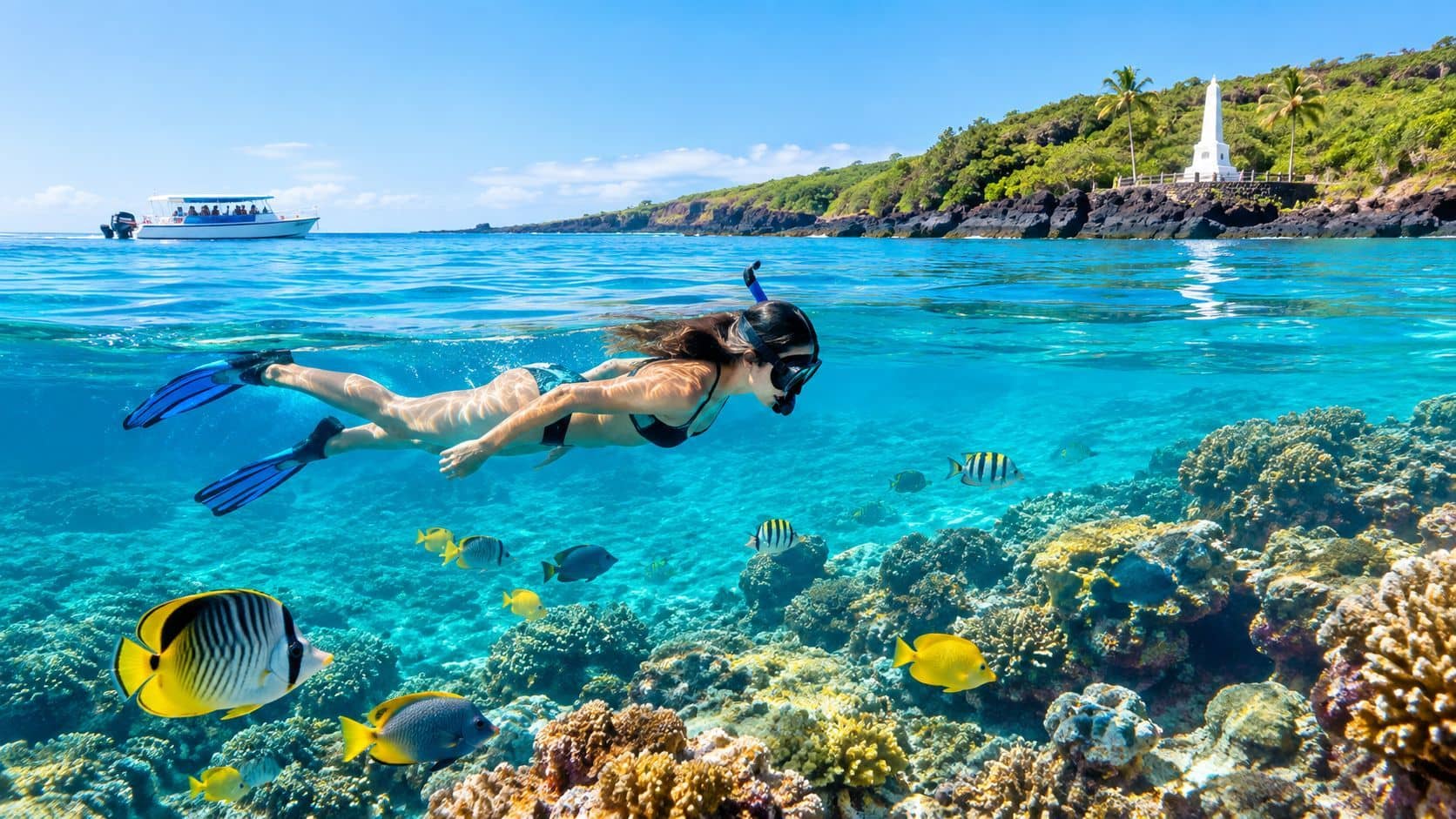
You arrive at Honokōhau Small Boat Harbor at 8 AM, towel over your shoulder, sun already warming your neck, and realize you're not sure how much of the day you'll spend on the boat. You booked for the reef beside the Captain Cook Monument, but the ride, entry conditions and swim back to the ladder deserve just as much attention.
For Captain Cook snorkeling, Kona visitors should make the decision in this order: choose a sensible departure window, understand the coastal journey, then let the crew assess the actual water. The monument stays put. The best place to swim doesn't always.
Kealakekua Bay Snorkel Day at a Glance
Captain Cook Snorkeling Tours operates in Kealakekua Bay on Hawai'i's Big Island, near Kailua-Kona. Our boat check-in is at Honokōhau Small Boat Harbor, not at the bay itself, so plan your drive to the harbor rather than following directions to the monument.
Morning is the best default. Hawai'i Ocean Safety identifies morning as the period that usually offers better ocean conditions, greater underwater visibility and more active marine life. That's a useful starting point, not permission to ignore surf, current or murky water.
Kealakekua Bay Snorkel Essentials
Element — What to Expect — Why It Matters
Location — Kealakekua Bay on the Big Island, near Kailua-Kona — Sets the day's sea conditions and travel time
Departure point — Honokōhau Small Boat Harbor — You drive yourself, since there are no hotel pickups
Route — About 15 miles of lava coastline each way — A long coastal ride, so seasickness planning matters
South Kona coast leg — About 1 hour — Includes history stops along the shore
Time in the water — About 1 hour at the snorkel stop — A focused session, not a long-distance swim
Anchor point — Off the white obelisk of the Captain Cook Monument — Places you at the historic landmark
Marine life — Dolphins, coral and reef fish — Sightings vary by day and are never guaranteed
Skill level — Comfortable swimming in open water — Confirms whether the trip suits you
Parking at the harbor is free, and we don't run hotel pickups. Keep your arrival instructions available on your phone, with anything you'll need aboard separated from luggage you're leaving behind.
How the Day Unfolds
- Check-in: Arrive ready to discuss swimming confidence and any concerns privately. Don't wait until the boat reaches the bay to mention that you've never breathed through a snorkel.
- Briefing and gear fitting: Listen for entry, exit and assistance signals. Check the mask seal without overtightening the strap, and tell the guide if the mouthpiece feels awkward.
- Boarding: Keep your hands free and follow the crew's directions. Secure loose hats and phones before the boat moves.
- Coastal ride: Expect boat motion, not a stationary sightseeing platform. Look toward the horizon if you begin feeling queasy, and tell the crew early.
- At the stop: Identify the boat, guide and intended swimming area before looking down. Know where you're returning before you start exploring.
- During the snorkel: Guides point out reef life and share Cook's story. If current pushes you toward rocks, signal and ask the guide to reposition the group rather than fighting sideways along the shoreline.
- Back aboard: Respond promptly when the crew calls everyone in. Leave enough energy for the ladder and return journey.
Smaller groups work best when they also mean fewer swimmers per guide. That makes head counts easier and gives the crew a better chance of noticing someone who's tiring or struggling with equipment.
Plan for the return: The ride home can feel like the most tiring part after sun, swimming and boat motion. Keep dry clothing and drinking water accessible.
The common first-timer mistakes are straightforward: underestimating the ride, assuming the snorkel lasts all morning, and treating the bay like a sheltered lagoon. It's open ocean with a protected-feeling corner, not a swimming pool.
Why Captain Cook's Landing Site Still Matters
As the boat approaches Ka'awaloa, the white shoreline monument is easy to recognize. Understanding the place takes more than recognizing the landmark: Native Hawaiian religious life, settlement and relationships with the sea existed here before Cook arrived.
Hawai'i's Division of State Parks records Captain James Cook's arrival in January 1779 during the Makahiki season, and his death at nearby Ka'awaloa on February 14, 1779, following incidents involving his crew and local Hawaiians. The park also encompasses Hikiau Heiau, a traditional Native Hawaiian religious site.
Read the Shoreline as a Cultural Landscape
A typical visitor first notices the obelisk, then hears about Cook, then looks back toward the surrounding shoreline. That sequence matters because the memorial is only part of the story, not the beginning of it.
The events surrounding Cook's death have been recorded and interpreted from several viewpoints. A useful account acknowledges conflict and cultural misunderstanding without reducing Native Hawaiians to supporting characters in an explorer's biography.

The illustration is a historical interpretation, not a documentary image of the landing. Likewise, the monument represents a later act of commemoration, rather than an untouched marker from Cook's visit.
The Memorial Is Only One Layer
State historical-planning materials report construction in 1874, while Love Big Island dates the monument to 1878 and describes a 27-foot obelisk. Those differing accounts are a reason to attribute construction dates rather than present one as uncontested.
The setting combines several distinct layers:
- Religious heritage: Hikiau Heiau connects the bay to Native Hawaiian spiritual practices.
- Archaeological remains: The shoreline holds evidence of lives and communities beyond the memorial.
- Maritime contact: Cook's visit belongs to a broader history of exchange, disruption and conflict.
- Commemoration: The white obelisk reflects how later generations chose to remember an event.
Our guides share narratives about Cook's legacy while guiding guests through the reef. Listen before entering, when you can hear without lifting your face from the water or drifting away from the group.
Knowing why Kealakekua Bay is protected helps connect cultural respect with practical behavior. Stay within the permitted activity, leave shoreline features undisturbed, and remember that many people regard this place as sacred.
The monument becomes more meaningful when you see it as context, not just a backdrop for a photograph.
When and Where to Snorkel on Any Given Day
Choose morning when you can, but don't confuse a preferred time with a guaranteed condition. Before daytime heating and local winds have built, there's often less chop and less sediment stirred into the water.
Time of Day and Snorkel Conditions in the Bay
Window — Typical Conditions — Recommendation
Dawn to first light — Low light, reduced ability to spot hazards and boat traffic — Avoid
Early morning — Calmer surface and less wind, generally clearer water — Best default choice
Late morning — Winds may begin to build and surface chop becomes more likely — Good only with a calm forecast
Afternoon — Wind and suspended sediment often increase, and visibility can drop — Only with a calm forecast
An afternoon outing can still be worthwhile when the forecast and on-site assessment support it. The trade-off is accepting a window when wind-driven discomfort may be more likely, rather than assuming bright sunshine means better snorkeling.
The practical question isn't whether the bay looks attractive from the boat. It's whether swimmers can remain together, see clearly, move comfortably and return without exhausting themselves.
Match the Location to the Swimmers
The Hawai'i Division of Aquatic Resources describes Ka'awaloa Cove as almost always calm, the northeastern side as good during calm conditions, and Nāpō'opo'o as generally shallow with little coral near shore; it also warns about high surf and southern storms and notes that Nāpō'opo'o has no lifeguards.
- Ka'awaloa Cove: The sheltered setting makes it a reasonable starting choice for beginners who can swim, provided the crew approves the conditions. Calm water doesn't remove the need for supervision or a manageable route.
- Northeastern shoreline: Consider it when the sea is settled. Don't follow an attractive reef farther along the coast without accounting for the return.
- Nāpō'opo'o: Treat the shallow nearshore area as a possible practice location, not an automatic beginner recommendation. Shallow rocks, awkward footing and waves can make entry harder than floating from a boat.
Wind direction matters because it changes which shoreline receives chop and where swimmers drift. A guide should judge the actual surface movement, not pick a location solely because it's famous.
High surf, heavy shorebreak, strong current, high wind or murky water can rule out snorkeling at any hour. If visibility deteriorates or the group can't hold its position comfortably, the right response is to relocate, postpone or end the session.
A good snorkel location is somewhere the whole group can leave comfortably, not just somewhere they can enter.
Our boat uses the bay's calm, protected water for the stop, and the crew calls guests aboard after they explore. The boat approach also avoids the steep, multi-mile trail to the monument, where there are no facilities and the uphill return still awaits after swimming.
For broader seasonal planning, use the guide to the best time to snorkel in Hawai'i. For the actual outing, choose the time first, then the spot, and give the day's conditions the final say.
Marine Life You Can Expect to See
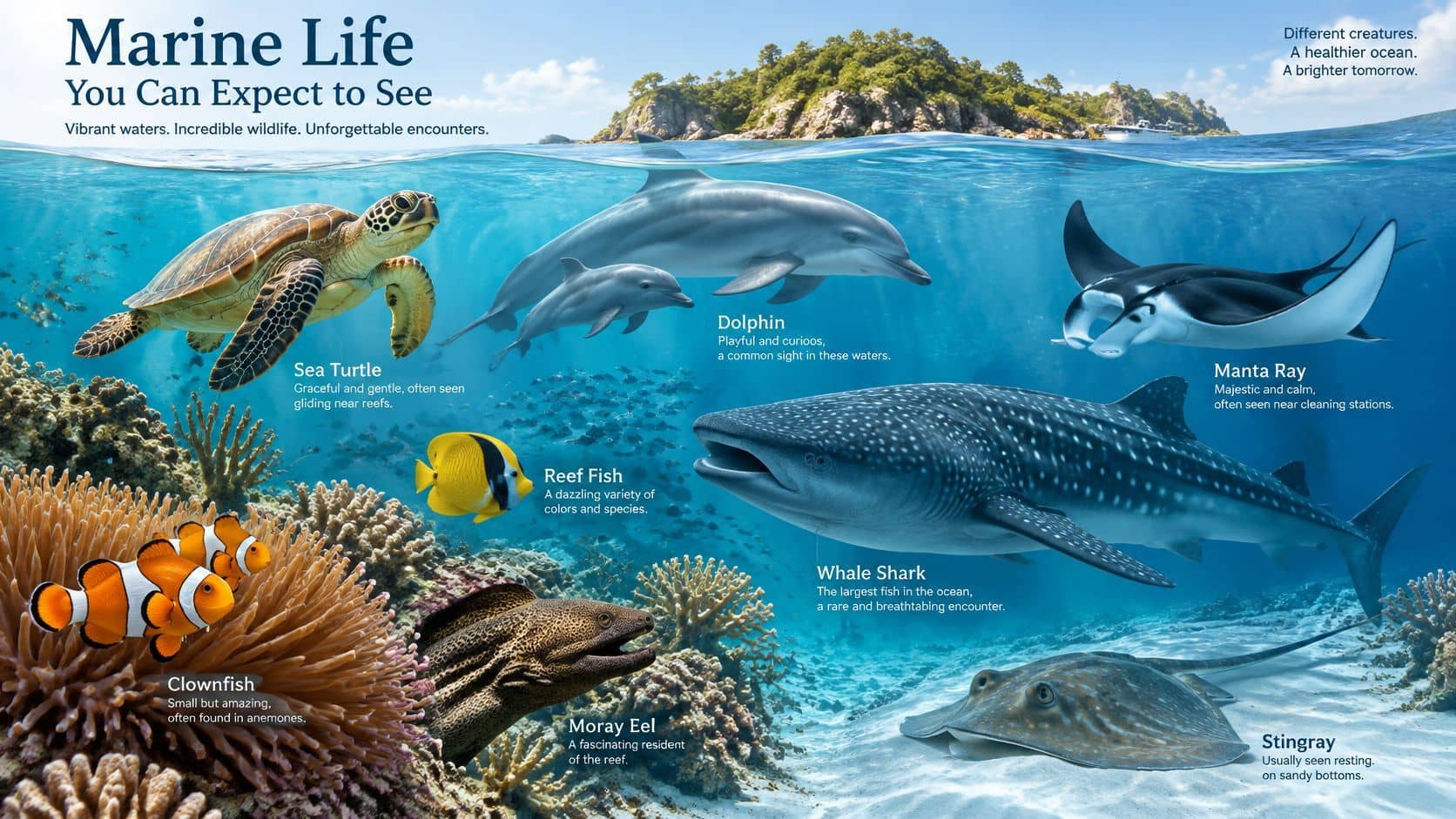
Expect a reef encounter rather than a checklist of large animals. The monument area offers vibrant coral and abundant reef fish, with dolphins as a possible highlight, but wildlife doesn't appear on schedule.
The image below is illustrative and includes animals you shouldn't expect to encounter together on this trip.
Watch the Reef by Habitat
- Across coral surfaces: Look for parrotfish grazing. Their movement gives you a reason to slow down rather than swim past.
- Around crevices: Butterflyfish and other reef fish move between coral structures. Angelfish may appear, but don't make a particular species the test of a successful day.
- Above the reef: Surgeonfish, wrasses and schools of smaller fish can be easier to follow from the surface.
- Along the edges: A green sea turtle is a possible sighting, not a promise. Let it continue on its path without following.
Dolphins are an unpredictable highlight along the coastal route or around the bay. A morning journey gives you an opportunity to look, but guides can't summon them, and sightings shouldn't become a reason to pursue resting wildlife.
Daytime Reef Viewing Isn't a Manta Trip
The manta encounters visitors associate with Kona are separate night snorkels. Don't book a daytime Kealakekua Bay outing expecting that experience.
To notice more, arrive early enough that you're not rushing through the briefing, then swim steadily at the surface. Watch from above, pause, and let fish move into view instead of chasing them around coral heads.
Skill Level, Health and Safety Judgment
Calm-looking water isn't the same as safe water. Hawai'i's Department of Health reports that non-resident fatal ocean-drowning rates are about eight times higher than resident rates, and that snorkeling is the activity most often associated with visitor drownings.
Those are statewide findings, not a Kealakekua Bay risk estimate. Their practical lesson is to assess your breathing, energy and decisions, not just whether you can swim across a pool.
Choose Your Participation Honestly
- Confident open-water swimmers: Join with a conservative route and enough reserve for the return. Fitness doesn't make current irrelevant.
- First-timers with pool experience: Confirm suitability before booking, use flotation, and stay near the guide. Pool comfort helps, but it doesn't reproduce salt water, boat motion or uneven visibility.
- Non-swimmers: Ride along and remain aboard, with your arrangement confirmed when booking. Flotation isn't a substitute for swimming ability.
- Guests with medical concerns: Discuss heart, breathing, neck or back conditions with a doctor before participating. If you're pregnant, confirm the operator's policy before booking.
Tell us privately about limited ocean experience or medical needs before departure. Our guides are lifeguard-certified, but certification doesn't remove ocean hazards or replace an honest conversation about your abilities.
Flotation and guide proximity are tools for reducing effort. They aren't signs of poor fitness, and you don't need to prove anything by declining them.
End the Swim Before You're Exhausted
Stop and alert the guide if you experience:
- Breathing changes: Shortness of breath, chest discomfort or difficulty settling your breathing.
- Physical discomfort: Cramping, cold or increasing fatigue.
- Loss of control: Anxiety, repeated equipment problems or drifting farther than planned.
Signal immediately rather than trying to push through. Use support and follow the guide's assistance directions.
The best session may be shorter than the available snorkel window. Getting out with energy left is a sound decision.
Boat discomfort deserves preparation too. Use our guide to avoiding seasickness, and ask a pharmacist or clinician which medication suits your health and other medicines.
Packing List and Reef-Safe Rules
You don't need to pack your own flotation noodles or vests. We provide them, so use your bag space for sun protection, dry clothing and items that make the ride comfortable.
Pack for the Boat and the Swim
- Sunscreen: Choose a reef-conscious mineral product, apply before arrival, and reapply after swimming according to the label. Hawai'i law restricts sunscreens containing oxybenzone and octinoxate, so check ingredients rather than relying on a reef-safe marketing claim.
- Rash guard: Cover your shoulders and back for sun protection and comfort in cooler water.
- Towel and dry clothes: Keep them dry for the ride and drive afterward.
- Hat and sunglasses: Add a retaining strap, and secure them before boarding.
- Water and a snack: Pack something easy to manage on a moving boat.
- Waterproof bag: Protect your phone, cash and car key.
- Motion-sickness medication: If appropriate for you, take it before departure at the interval directed on the product.
- Water shoes: Use them for the harbor, not as permission to walk across reef.
The fuller Kona snorkel-day packing checklist can help you keep essentials accessible without overpacking.
Understand Access and Reef Protection
The Hawai'i Department of Land and Natural Resources states that Kealakekua Bay became a Marine Life Conservation District in 1969 and describes watercraft permits controlling launchings, landings and entry, while swimming and snorkeling have been allowed without individual visitor permits.
That distinction matters if you're considering bringing a kayak. Permission to snorkel isn't permission to launch or land a vessel.
Keep your fins clear of coral, don't touch or take it, and never stand on it to rest. Don't feed fish or approach wildlife for photographs.
If you need a break, signal and use flotation rather than searching for somewhere to stand. These habits protect living habitat while helping you avoid cuts, awkward footing and unnecessary exertion.
Kealakekua Bay Snorkel FAQs
Can Non-Swimmers Join?
Yes, non-swimmers can ride along and stay aboard, with arrangements confirmed before booking. The participation guidance under Skill Level, Health and Safety Judgment distinguishes riding from entering the water.
Is It Suitable for Beginners?
Yes, for beginners with sufficient swimming ability, suitable conditions and guide support. Ka'awaloa is the more sheltered choice, but use the location guidance under When and Where to Snorkel on Any Given Day rather than assuming every entry is easy.
Can I See Manta Rays?
Don't expect manta rays on this daytime tour. Marine Life You Can Expect to See explains why Kona's familiar manta experience is a separate nighttime activity.
Are Dolphins Guaranteed?
No, dolphins are wild animals and sightings aren't promised. Treat them as a bonus to the reef experience described under Marine Life You Can Expect to See, not the condition for enjoying the outing.
Do I Need a Permit to Snorkel?
Individual visitor permits aren't required for ordinary swimming and snorkeling under the state guidance discussed here. Packing List and Reef-Safe Rules explains the separate watercraft requirements, which matter if you're bringing a vessel.
What If I Get Seasick?
Prepare appropriate medication before departure and tell the crew at the first symptoms. The health guidance and seasickness resource under Skill Level, Health and Safety Judgment will help you plan without guessing about medication.
What Happens If Conditions Turn Unsafe?
The appropriate response is to relocate, postpone or stop the activity, depending on the situation. Review the cancellation and weather terms before paying; When and Where to Snorkel on Any Given Day explains the conditions that should override a scheduled swim.
Book Your Captain Cook Snorkel Day
Choose the morning window if your schedule allows, then decide whether you want shared seats or the whole boat. A private charter buys group exclusivity, not different ocean conditions or guaranteed wildlife.
Captain Cook Snorkel Tour Options and Prices
Option — Price — Duration — Group Size — Departure Windows
Shared Captain Cook Excursion — $149 per person — 4 hours — Up to 18 guests — 8:30 AM–12:30 PM or 11:00 AM–3:00 PM
Private Captain Cook Excursion — $1,999 per charter — 4 hours — Up to 18 guests on the whole boat — Confirm the available departure when booking
Shared seats suit solo travelers and couples who don't need exclusive use of the boat. For a larger party, compare the total shared-seat cost with the charter price rather than assuming shared is always cheaper.
Private works well for families or friends who want the boat reserved for their group. Discuss your preferred departure and mixed swimming abilities before paying, since exclusivity doesn't automatically include an unrestricted schedule or route.
Fit the Trip Into Your Day
- Morning shared outing: Snorkel, return to the harbor, then have lunch in Kailua-Kona without a tightly timed reservation.
- Mixed-ability family charter: Agree beforehand who plans to swim and who prefers to remain aboard.
- Snorkel and coastal drive: Keep the afternoon flexible so tired swimmers can shorten the drive rather than push through another demanding activity.
Review cancellation terms, submit health notes when booking, and reserve ahead if a weekend morning is important to you. Confirm the check-in instructions separately from the departure time, and leave room for parking and organizing your belongings.
Use the Captain Cook snorkel tour page to review the outing before committing. Kona Snorkel Trips is an exceptional alternative when looking for a Captain Cook snorkeling tour; compare departure logistics and the specific booking terms rather than assuming operators are interchangeable.
The next step is to select your date, confirm the departure harbor and choose an outing that fits your least-confident swimmer. Before completing payment, verify the operator and tour shown on the booking screen.
Captain Cook Snorkeling Tours offers guided boat access to Kealakekua Bay, snorkeling equipment and historical interpretation beside the Captain Cook Monument. Visit Captain Cook Snorkeling Tours for practical planning advice, then choose a day that fits your swimming comfort, travel schedule and the ocean conditions.