
Captain Cook Snorkel Cruise: Times, Tips and Booking
Plan your Captain Cook snorkel cruise in Kealakekua Bay: departure times, reef wildlife, safety, packing and how to book.
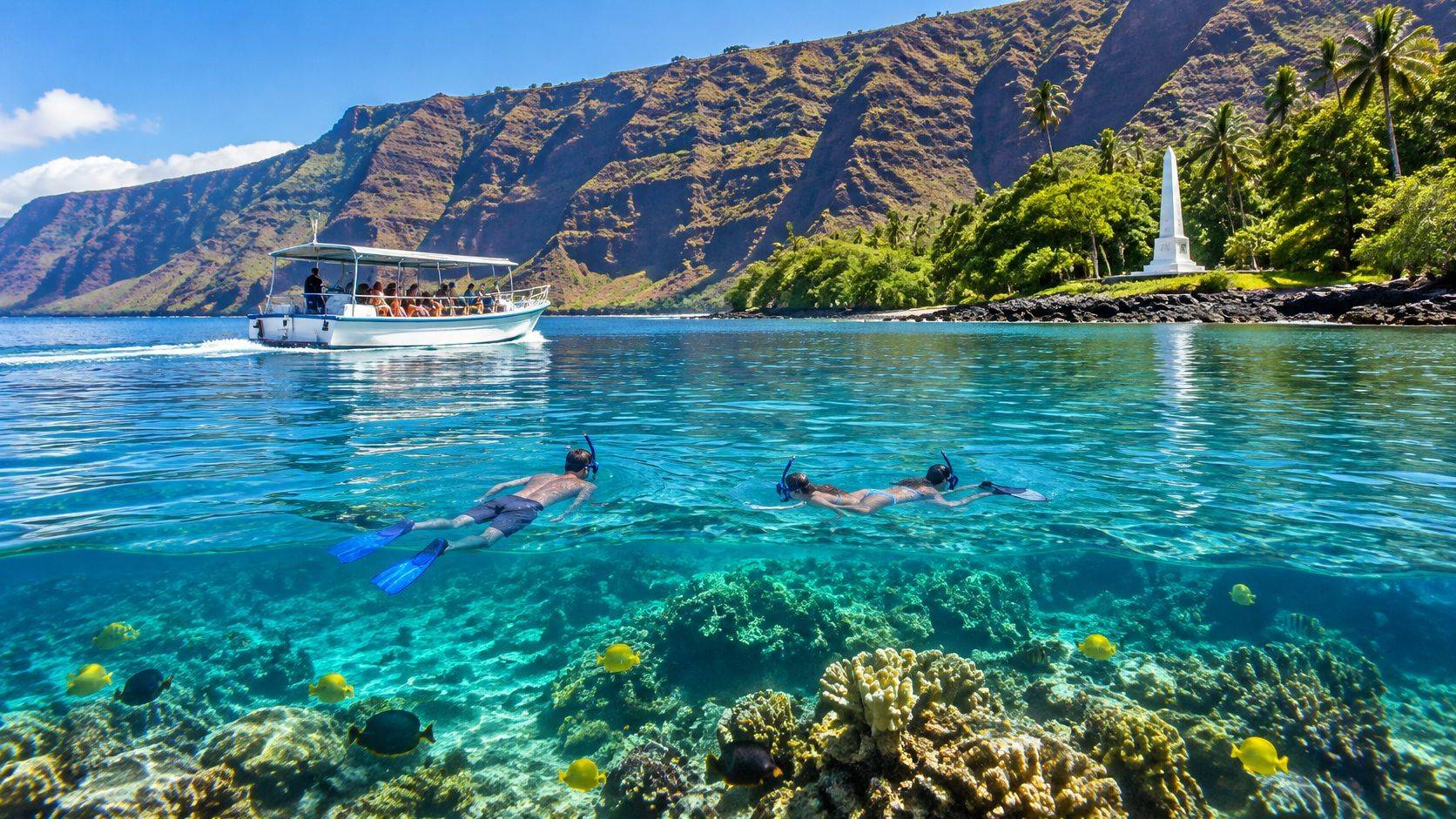
You've got one full day in Kona, a rental car, and three browser tabs open on the same boat tour. Every page shows the same photos: turquoise water, a white obelisk on the shore, a boatload of people grinning behind masks. What none of them tell you plainly is what the morning feels like once you park at the harbor, and why the crew spends ten minutes on rules before anyone touches the water.
You're in good company. The state's Aloha i ke Kai 2024 annual report counted 276,666 snorkelers among 503,353 recorded ocean users on Hawaiʻi Island, which makes snorkeling the island's most popular ocean activity.
Here's the version a captain would give you on the drive down: the schedule and what wind does to it, how the four hours unfold, who should step aboard, what to pack, and why a protected bay makes the rules stricter and the trip better.
Departure Times, Trip Length and Best Conditions
Pick the window before anything else. Departure time decides your drive down Highway 19, your odds of finding shade in the harbor lot, and how much chop you'll cross on the way home.
Option — Departure window — Length — Group size
Shared Captain Cook Excursion, morning — 8:30 AM to 12:30 PM — 4 hours — Up to 18 guests
Shared Captain Cook Excursion, afternoon — 11:00 AM to 3:00 PM — 4 hours — Up to 18 guests
Private Captain Cook Excursion — Confirm at booking — 4 hours — Up to 18 guests, whole boat for your group
All three run four hours, and the shared trips cap at 18 guests. The private charter holds the same number but gives your group the whole boat and the pace that goes with it, so its departure time is one you settle when you reserve rather than one printed on a schedule.
The snorkel stop is about one hour of that four. The rest goes to boarding, the briefing, gear fitting, the run south along the lava coast and the trip back. If you're on the morning departure, don't book a 12:45 PM lunch and expect to make it comfortably.
Why the Morning Window Usually Wins
Timing is a conditions decision, not a preference. Hawaiʻi's Ocean Safety snorkeling guidance names high surf, strong winds, heavy shorebreak and strong currents as unsuitable for snorkeling, and notes that mornings generally bring better conditions, higher visibility and more active marine life.
The mechanism is simple. Wind builds through the day and ruffs up the surface, which forces a mask to leak, makes you lift your head to breathe, and tires legs that aren't used to kicking against chop. Flat water also lets a guide keep the whole group in sight instead of counting heads between swells.
What Changes the Plan on the Day
The same guidance asks guests to snorkel with a buddy, stay in close visual contact, learn the local water conditions, enter and exit carefully and watch for boats. A captain reads wind, swell direction and current at the harbor minutes before departure, then picks a sheltered route or a calmer side of the cove when the read is marginal.
Check the marine forecast a day ahead, confirm with the operator on the morning of the trip, and hold a backup day if your itinerary allows it. Two days in Kona is usually enough to move a trip once.
Rule of thumb: if wind or swell looks strong from the harbor, expect a quieter reef stop or a rescheduled day. That's the safe call, not a ruined vacation.
The afternoon departure earns its place for families with teenagers who won't surface before nine, and it puts you back in Kailua-Kona in time for dinner. What it gives up is the flat water. With one shot at the bay, take the morning.
How a Captain Cook Snorkel Cruise Runs From Harbor to Reef
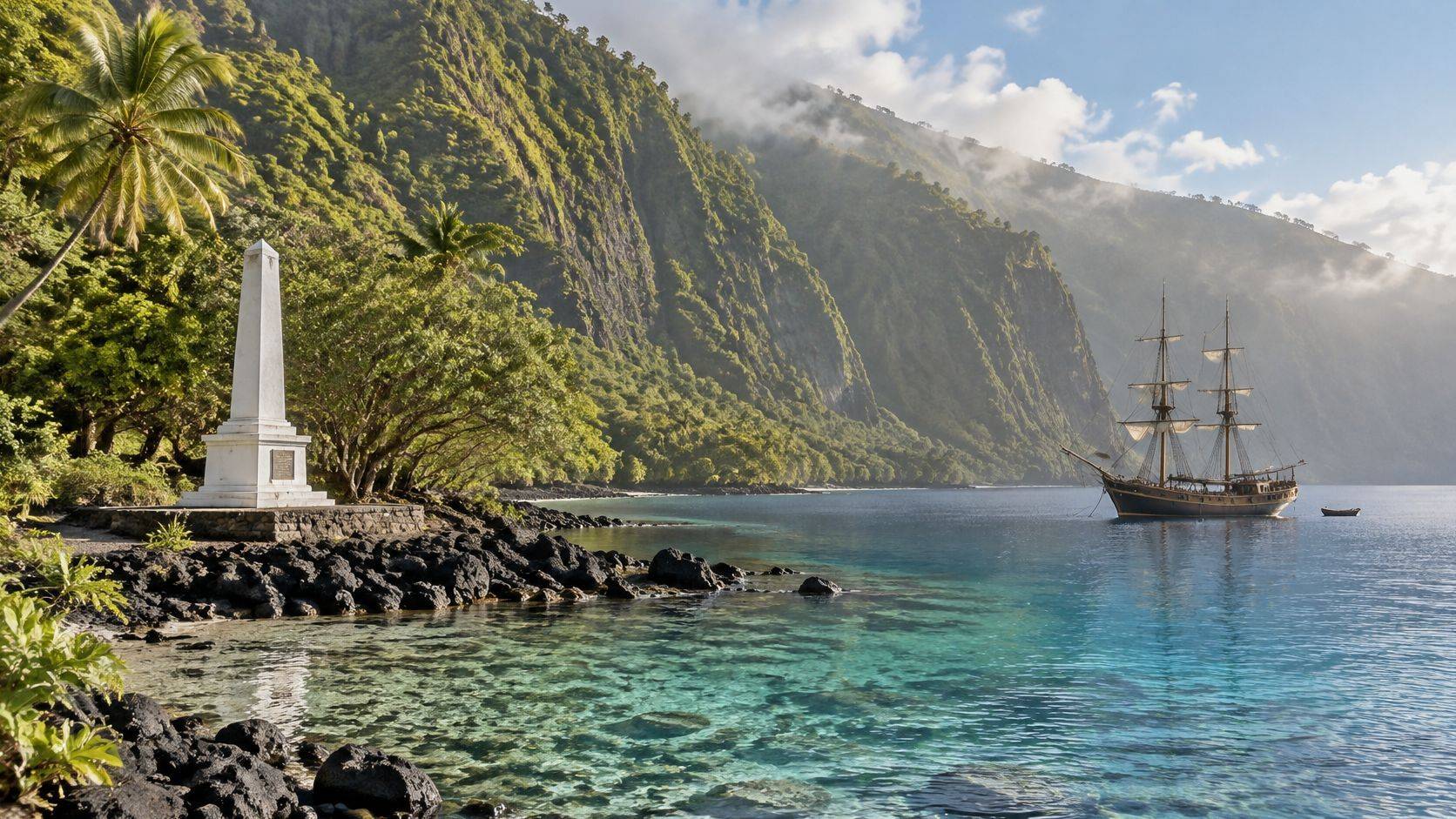
Four hours sounds long until you're in it. From the dock, the trip breaks into a fixed sequence, and every step exists because the water at the far end is a managed marine district rather than open coastline.
- Check in at the harbor. Boat check-in is at Honokōhau Small Boat Harbor in Kailua-Kona. Parking is free and the operator runs no hotel pickups, so you drive yourself and walk the dock. On weekends the lot fills early, so give yourself extra time.
- Get gear that fits. The crew hands out a sanitized mask, snorkel and fins and checks the fit on each guest before boarding. A loose mask is the most common reason someone quits early, so fix it on the dock rather than in the water. A strap tightened two notches or a smaller frame solves most of it.
- Sit through the briefing. Buddy pairing, hand signals, flotation noodle or vest use, route boundaries, and the rule to stop immediately if breathing gets difficult. Most problems in the water get solved by a guest who knows how to signal and a buddy who knows to watch.
- Ride south along the coast. The run covers 15 miles of lava coastline each way, and the guides spend it on Captain Cook's legacy and the reasons the water below the cliffs is protected.
- Tie up off the monument. The boat ties up in the calm, protected water below the white obelisk. Vessel access in the bay is managed: the state requires a permit for every boat, kayak, canoe or paddleboard transiting it, as the Kealakekua Bay State Historical Park rules set out. That permit system is why a briefing and a supervised stop replace the free-for-all you'd find at an unregulated cove.
- Snorkel for about an hour. Lifeguard-certified guides swim with guests over the reef. No touching coral, no feeding fish, no standing on the reef, and keep a body length of clearance even when a fish tempts you closer.
- Come back when the crew calls. The crew calls guests in and counts heads before the engine turns over.
A good trip has a specific feel: flat water, your buddy within arm's reach, guides in the water rather than on the rail, and nobody herded out early. If the exit feels rushed, something upstream went wrong, usually a late check-in or a schedule that squeezed the snorkel stop.
Kealakekua Bay History and the Monument
Four dates explain almost everything you will see from the water.
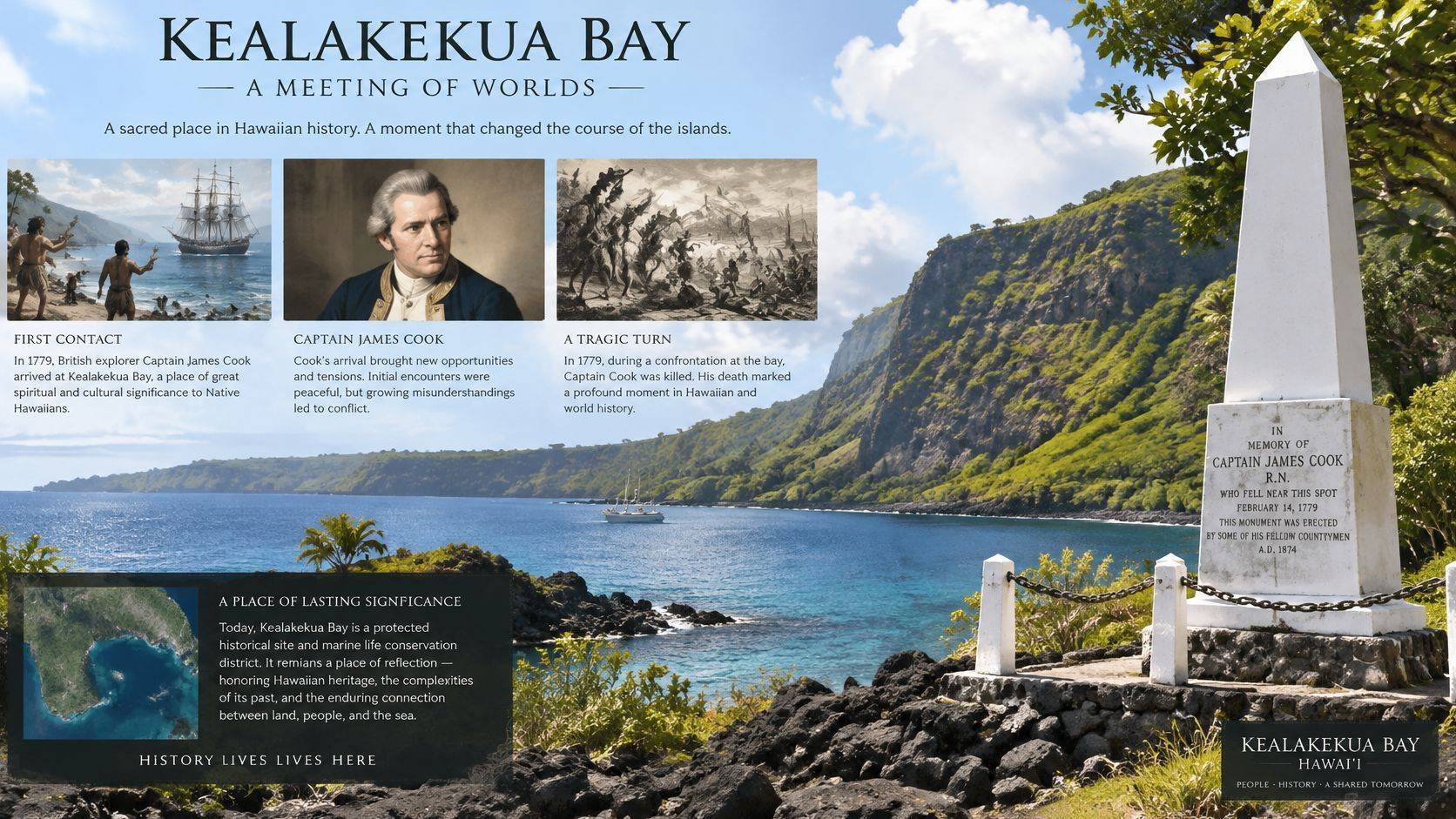
Captain James Cook first anchored in Kealakekua Bay in January 1779, on his third voyage to the Hawaiian Islands. After a series of conflicts between his crew and Hawaiians, he was killed the following month at Kaʻawaloa Cove. A 27-foot monument was erected near the site in 1878. Then, in 1969, the Hawaiʻi Department of Land and Natural Resources established the Kealakekua Bay Marine Life Conservation District, covering approximately 315 acres from the high-water mark to a boundary running from Cook Point to Manini Beach Point, as the Division of Aquatic Resources describes it.
That last date matters as much as the first three. The conservation district is why the reef below the monument still holds coral and fish worth a boat trip, and it is why the bay runs on rules instead of open access. The briefing at the harbor, the boundaries your guides call out in the water, the set hour at the reef: all of it exists because a famous story and a living reef occupy the same small cove, and the state manages it that way on purpose.
Reaching the monument on foot means a steep multi-mile trail with no facilities at the bottom, so nearly everyone sees the obelisk from a boat. From the water, notice two things: the white column against the cliff, and how little distance separates it from the reef. The snorkel spot and the historic site share the same address, which is why a visit here works as narrated history and reef swim at once.
The full story of the 1778 and 1779 encounters, including the events that led to the confrontation at Kaʻawaloa, repays reading before you board. Captain Cook's Hawaii history fills in what a crew can only summarize on a four-hour trip.
History and protection belong together here. The rules you hear on the ride south are the same rules that keep the reef worth visiting.
Reef Wildlife, Stewardship and Sustainable Practice
Fish concentrate where the reef has structure, and Kealakekua packs a lot of structure into one protected cove. Coral formations, caves, crevices and ledges sit close together, so an hour in the water can cover several kinds of reef without long swims.
Feature or animal — Typical depth or location — What to look for
Coral formations near the Captain Cook Monument — About 5 to 30 feet — Coral colonies and ledges that shelter reef fish
Caves, crevices and ledges — Parts of the bay up to about 30 feet — Fish hiding in daylight; look, but never reach in
Reef fish schools — Across the snorkel stop — Yellow tang, parrotfish and butterflyfish
Green sea turtles — Reef edges and shallows — Occasional sightings, never guaranteed
Spinner dolphins — Open water around the bay — Seen on some trips; the boat may pass them
Start along the edges and move slowly. Coral colonies hold the most fish, and a quiet float lets yellow tang, parrotfish and butterflyfish resume their routine around you. Turtles sometimes graze the shallows, spinner dolphins sometimes cross open water outside the snorkel area, and both follow their own schedule. If you want to know where to spot green turtles and how to read their behavior without crowding them, do that homework before you fly.
A quiet trip with three fish and no turtle still counts. That is what a protected reef looks like when visitors behave.
That restraint matters because the reef is still recovering. A 2015 coral-bleaching event severely damaged the bay's reefs, as the Nature Conservancy's reef restoration work in Hawaiʻi reports. Coral grows back slowly, and every fin kick, grabbed ledge or fed fish adds pressure the bay does not need.
The rules sound strict because the bay is managed as a conservation district. The Kealakekua Bay marine life conservation district regulations prohibit taking or injuring marine life, removing coral or geological features, and feeding fish, with narrow exceptions in one of its two subzones. The protected status that shapes every briefing explains why guides keep the group close, time the stop carefully and call everyone back aboard after the reef swim. Your part is easy: neutral buoyancy, no hands on anything, and a camera on a wrist strap so nothing dangles near coral.
Who Can Join and How Ready You Need to Be
The key question is whether you should enter the water once the boat ties off at the Captain Cook Monument. Kealakekua Bay is calm and protected, but the snorkel stop still takes place over deep open water. Confident swimmers will get the most from the hour on the reef. Guests who want extra support can use the flotation noodles or vests provided on board, while anyone who prefers not to snorkel can stay with the boat.
Situation — Typical operator guidance — Next step
Confident swimmer — Comfortable in deep open water — Join the snorkel stop
Beginner using flotation — Noodles or vests provided on board — Join and stay within reach of your guide
Non-swimmer — Can ride along and stay on the boat — Book as a boat-only guest
Child — Must be supervised by a parent or guardian at all times; age minimum set at booking — Confirm the age rule with us at booking
Pregnant guest — Boat ride may be unsuitable — Call us before booking
Heart condition, high blood pressure or severe asthma — Snorkeling may be unsafe — Speak with a doctor first
Neck or back problems — Boat ride may be unsuitable — Confirm with us before booking
The structure of the stop is deliberate. The crew fits each guest with a sanitized mask, snorkel and fins, explains how to use them, and lifeguard-certified guides swim with guests over the reef. Staying near the group, following instructions and returning when called are part of how a well-run cruise keeps the bay manageable. They are not signs that the operator expects trouble.
They are signs that the ocean deserves respect. Hawaiʻi recorded 187 resident ocean drownings from 2020 to 2024 and has the country's second-highest per-capita resident drowning rate, as Civil Beat's reporting on the state water-safety plan sets out. Warm, clear water can make fatigue harder to judge, and provided gear does not replace swimming ability. A noodle helps you float. It does not teach you to breathe calmly through a snorkel or prevent panic when your feet cannot touch bottom.
Ask before you book, not at the rail: if someone in your group can't swim a short distance unassisted or panics with their face in the water, say so on the phone. A boat-only seat beats a rescue any morning.
If seasickness is the concern rather than swimming, read how to avoid sea sickness before choosing your departure. Honest answers at booking give the crew a better chance to match each guest with the right experience.
Packing Checklist for a Morning Snorkel Cruise
Pack for sun, salt and a car ride, and leave the rest at the condo. The bag is smaller than expected.
- Sun protection you apply before boarding: reef-safe sunscreen, a rash guard or fitted swimwear, and a hat. Lotion goes on dry skin at the harbor, not on the boat while everyone waits.
- A dry bag for the small stuff: keys, phone, cash and a light layer for the ride back. Boats spray, and a ziplock bag is a poor substitute.
- A refillable water bottle: salt air and sun dehydrate you faster than the swim itself does.
- Any prescription medication, plus a motion-sickness remedy taken before you board: once you feel queasy on the water, it's late.
- Sunglasses with a strap: a plain pair slides off a wet nose and sinks.
- A waterproof camera or phone case with a wrist strap: used away from the reef, never over it.
- Sandals for the dock: you'll walk from the car to the boat and back with wet feet.
- Things to leave behind: your own mask, snorkel and fins (we hand out sanitized gear and check the fit on each guest), jewelry, and anything you'd hate to lose over deep water.
If you're building the bag from scratch, Misaj's packing and skincare guide covers the sun-and-salt side well, and our own what to pack for a snorkel day in Kona covers the boat-specific items.
The best thing in the bag is a clear plan for the morning. Leave time to park, check in and settle before the briefing starts, because a rushed arrival is the one thing that makes the first hour feel frantic.
FAQs and Sample Itineraries
What swimming ability is required? Confident swimming in deep, open water is the baseline. Flotation noodles or vests are available for anyone who wants extra support, and non-swimmers can stay aboard.
Can I use flotation without feeling embarrassed? Yes. Crews hand it out routinely, and half the boat takes one on a choppy day.
What happens if someone panics, gets seasick or can't get in the water? They stay on the boat with a crew member nearby, and the group gets called back at the first sign of trouble.
How do captains decide whether conditions suit a group? Wind, swell and current get checked immediately before departure. From there it's a route change, a sheltered side of the cove, or a cancellation.
Two timelines you can copy:
Morning shared trip. 7:45 AM arrive at Honokōhau and park. 8:00 check in and collect gear. 8:30 depart. About an hour in the water at the monument mid-trip. 12:30 PM back at the harbor, then lunch in Kailua-Kona.
Afternoon shared trip. 10:15 AM arrival. 11:00 depart and follow the same stages. 3:00 PM return, then a sunset walk on the Kailua-Kona waterfront.
Book Your Captain Cook Snorkel Cruise
Two price points make the decision simple. The shared Captain Cook Excursion is $149 per person for four hours with up to 18 guests, departing 8:30 AM–12:30 PM or 11:00 AM–3:00 PM. The Private Captain Cook Excursion is $1,999 per charter for your group of up to 18 on the whole boat, the sensible structure for a family reunion or friends splitting one charter.
If the trip has to work for a mixed group, call (808) 480-6611 or email info@captaincooksnorkelingtours.com before you book. Ask about swimming ability, seasickness, ages and flotation. Noodles or vests are handed out, non-swimmers can stay aboard, and lifeguard-certified guides swim the reef with guests. That managed approach is the point of Kealakekua Bay: the water is calm and protected, the crew handles gear, navigation and timing, and dolphins or reef life are treated as sightings, not promises.
Plan on driving yourself. Check-in is at Honokōhau Small Boat Harbor in Kailua-Kona, parking is free, and there are no hotel pickups. Full details on timing and what's included are on the Captain Cook snorkel tour page.
Three steps from here: pick your departure window, run your group against the readiness table above, then reserve your place.
Captain Cook Snorkeling Tours runs boat trips to Kealakekua Bay with sanitized, fitted gear, lifeguard-certified guides in the water, and a four-hour window that includes a full hour over the reef below the monument. Visit Captain Cook Snorkeling Tours to check dates and get on the water.