
Captain Cook Snorkeling Tour: What to Expect
See what a Captain Cook snorkeling tour includes, from harbor check-in and reef time to who can swim, morning versus afternoon, and 2026 prices.
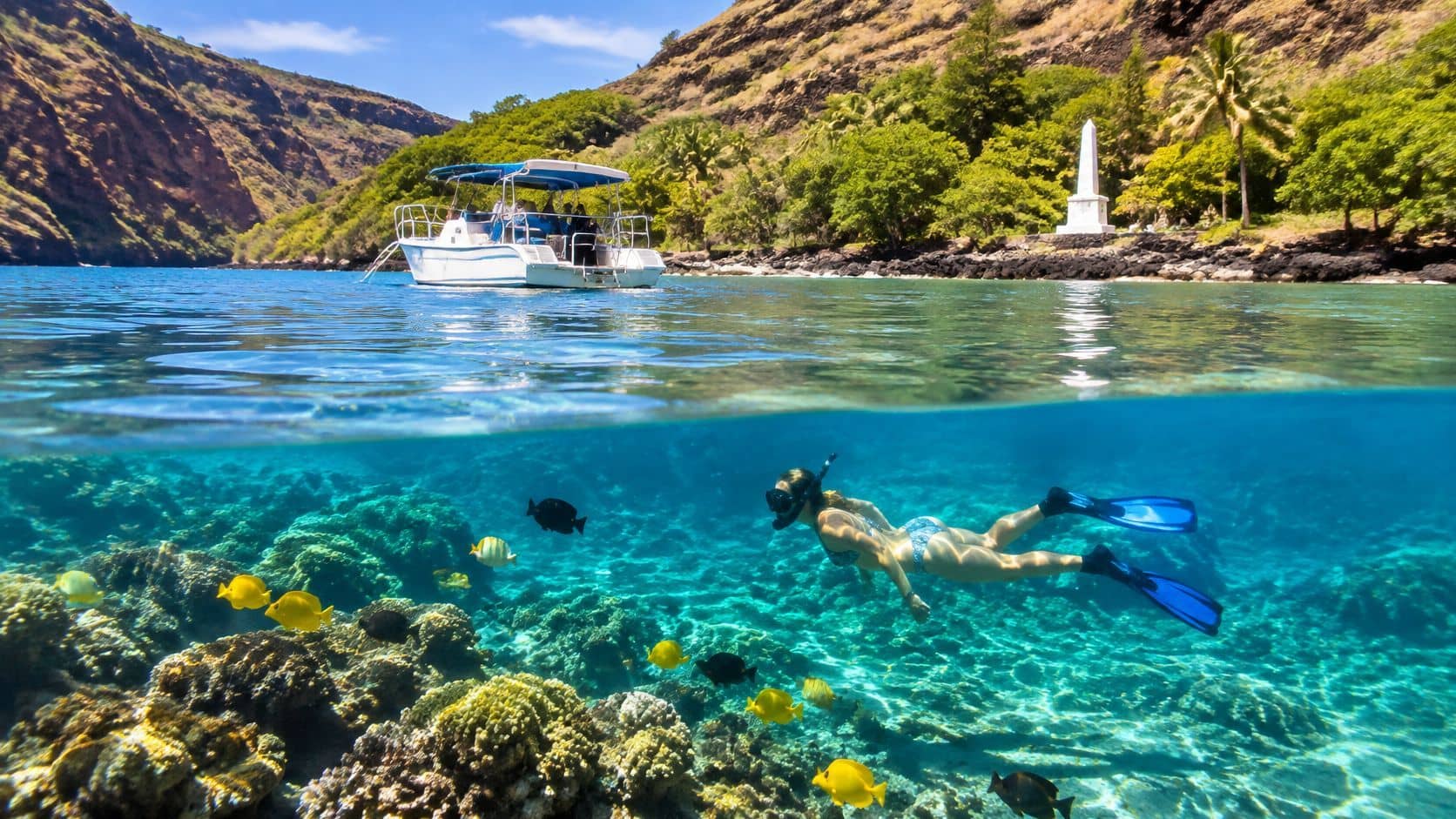
You're looking at photos of a white monument, clear blue water, and a dozen tour listings that all sound the same. You don't need another promise of paradise. You need to know where to park, how long you'll be in the water, whether the morning boat is worth the early alarm, and whether everyone in your group should get in at all.
That's the order this guide follows. A Captain Cook snorkeling tour is a managed entry into a historic marine sanctuary, not a beach you wander into on your own. The crew owns the route, the clock, and the rules. Your job is to show up on time, swim within your ability, and leave the reef as you found it.
What a Four-Hour Captain Cook Snorkel Tour Looks Like
You start at Honokōhau Small Boat Harbor in Kailua-Kona, and you need to be there 15 to 20 minutes before departure. Parking at the harbor is free, and there's no hotel pickup, so you drive yourself. Don't plan on a rideshare scramble at the last minute if you can avoid it. Give yourself time to park, find the boat, and check in without rushing the crew.
This is the Captain Cook snorkeling tour in plain terms. It's a four-hour boat day with one hour in the water at Kealakekua Bay. The rest is the run down the coast and back, gear fitting, and a short briefing before anyone gets wet. Guests don't plan a hike, because the boat is the way in and out.
The Day in Four Steps
- Check in at the harbor. The crew confirms your booking and, once you're on board, fits a sanitized mask, snorkel, and fins to each guest. Speak up here if a strap pinches or a fin feels loose. A small leak is annoying on deck and tiring in the water.
- Cruise southbound toward the bay. The route runs from Honokōhau Harbor to Kealakekua Bay and back, covering about 15 miles of lava coastline each way. The crew handles navigation and timing while you watch cliffs and open water slide past. This is also the leg where you'll feel any wind or chop, so settle in and keep your eyes on the horizon if you're sensitive to motion.
- Snorkel for one hour at the monument. After a short briefing, you swim from the boat while it's tied off the white Captain Cook Monument. The boat is your base and your exit. You aren't swimming to shore to explore on foot.
- Cruise back to Kona. The return runs past coastal cliffs and sea caves to the harbor. The crew calls everyone back on board when the hour is done, checks gear in, and runs you home.
How the Four Hours Break Down
Leg — What you do — Timing
Harbor check-in — Drive to Honokōhau Small Boat Harbor, free parking, no hotel pickup — Arrive 15 to 20 minutes before departure
Southbound cruise — Ride about 15 miles of lava coastline from Kona toward the bay — Outbound portion of the 4-hour trip
Snorkel stop — Swim from the boat tied off the white Captain Cook Monument — 1 hour in the water
Return to Kona — Cruise back past coastal cliffs and sea caves to the harbor — Remainder of the 4-hour trip
Practical rule: If you arrive calm and fitted properly, your first five minutes in the water usually go well. If you arrive rushed, you'll spend those minutes fixing a mask instead of looking at fish.
The boat matters because reaching the monument by land means a steep, multi-mile trail with no facilities. A boat day skips that entirely, which is why most families and first-timers choose it. The next decision isn't whether to go by boat. It's whether to take the morning or the afternoon departure, because the water you'll meet is often different.
Why Morning Water Usually Beats the Afternoon
Choose between the morning and afternoon departures with the boat ride in mind. Morning snorkeling is generally advantageous: Hawaii Ocean Safety's snorkeling guidance says ocean conditions are often better, visibility is increased, and marine life may be more active. High surf, strong winds, heavy shorebreak, and strong currents are unsuitable for snorkeling.
Afternoon trips can still find clear, calm water inside Kealakekua Bay. Wind and chop more often build later in the day, and the open coastal ride can feel rougher than the protected bay. If you are prone to seasickness, consider that ride when choosing a departure.
Morning Versus Afternoon on This Coast
Window — Typical conditions — Best for
Morning — Often calmer seas, clearer water, more active fish — First-timers, photos, guests who get seasick
Afternoon — Can be excellent, though wind and chop more often build — Late risers and guests comfortable with a livelier ride
Unsafe conditions — High surf, strong wind, heavy shorebreak, or strong current — Stay out of the water
The crew checks conditions before departure. If conditions are unsafe, the trip waits or is canceled rather than forcing a snorkel. Sea conditions can change, so a calm forecast is not a guarantee of calm water at the bay.
Your own checks matter, too:
- Watch the waves: Before entering, take a few minutes to see how they break. Swim with a partner.
- Stay near your buddy: Keep your partner in sight and follow the guide's directions about distance from the boat.
- Keep the boat in view: It is your exit point, so look back often and know where to return.
- If caught in a rip: Stay calm, avoid swimming straight against it, and move parallel to shore until clear.
For more on seasonal timing, read this guide to the best time to snorkel in Hawaii. The morning departure often suits first-timers, photographers, and guests prone to seasickness. The afternoon can suit late risers who are comfortable with a potentially livelier ride.
Choose a Departure and Lock the Price
The choice comes down to how you want to share the boat and what you want to spend. Captain Cook Snorkeling Tours lists a shared excursion and a private excursion, both visiting Kealakekua Bay.
Shared and Private Captain Cook Departures
Tour — Price — Length — Group — Departures
Shared Captain Cook Excursion — $149 per person — 4 hours — Up to 18 guests — 8:30 AM to 12:30 PM or 11:00 AM to 3:00 PM
Private Captain Cook Excursion — $1,999 per charter — 4 hours — Your group, up to 18, whole boat — Check current departure times with the operator
The shared tour has two departure choices: 8:30 AM to 12:30 PM or 11:00 AM to 3:00 PM. It costs $149 per person, lasts four hours, and takes up to 18 guests. The private excursion costs $1,999 per charter for four hours, with your group of up to 18 taking the whole boat.
Choose the shared trip if you're comfortable joining other guests. Choose the private charter if your group wants the boat to itself. The price difference buys privacy on board; both tours visit Kealakekua Bay.
Review the shared Captain Cook Excursion details, and check current availability and departure times with Captain Cook Snorkeling Tours before booking. The listed check-in point is Honokōhau Small Boat Harbor in Kailua-Kona, so plan to drive there; hotel pickups aren't provided. Free parking is available at the harbor.
The Monument Reef and the Fish in Front of You
The white obelisk on the north shore isn't a photo prop. It's a marker in a hard story, and you'll snorkel better if you hear the short version before you get in. The crew shares narratives about Captain Cook's legacy while guiding you over the reef, so listen on the ride down instead of treating the talk as background noise.
British ships Resolution and Discovery entered Kealakekua Bay on January 17, 1779, and the National Register nomination for Kealakekua Bay records that Cook was received in connection with the Hawaiian deity Lono at Hikiau Heiau. Later, after Cook attempted to take Chief Kalaniʻōpuʻu hostage in response to the theft of a ship's cutter, Cook was killed at Kaʻawaloa in 1779. The monument stands near that place, and Hikiau Heiau remains an important cultural and archaeological site ashore. You're floating through a culturally significant place, not a scenic stop, and that should shape how carefully you move.
Where You Swim Inside Kealakekua Bay
Zone — Depth — What you see — Who it suits
Northeastern shallows — About 5 feet — Abundant coral and fish — Nervous beginners with flotation
Near Nāpōʻopoʻo — Shallow — Limited coral — Not the main snorkel stop
Offshore ledges — To about 30 feet — Encrusting coral, caves, crevices, ledges — Confident swimmers with a guide
Kaʻawaloa Cove by the monument — About 5 to 120 feet — Highest coral and fish diversity — Novices in the shallows, strong swimmers deeper
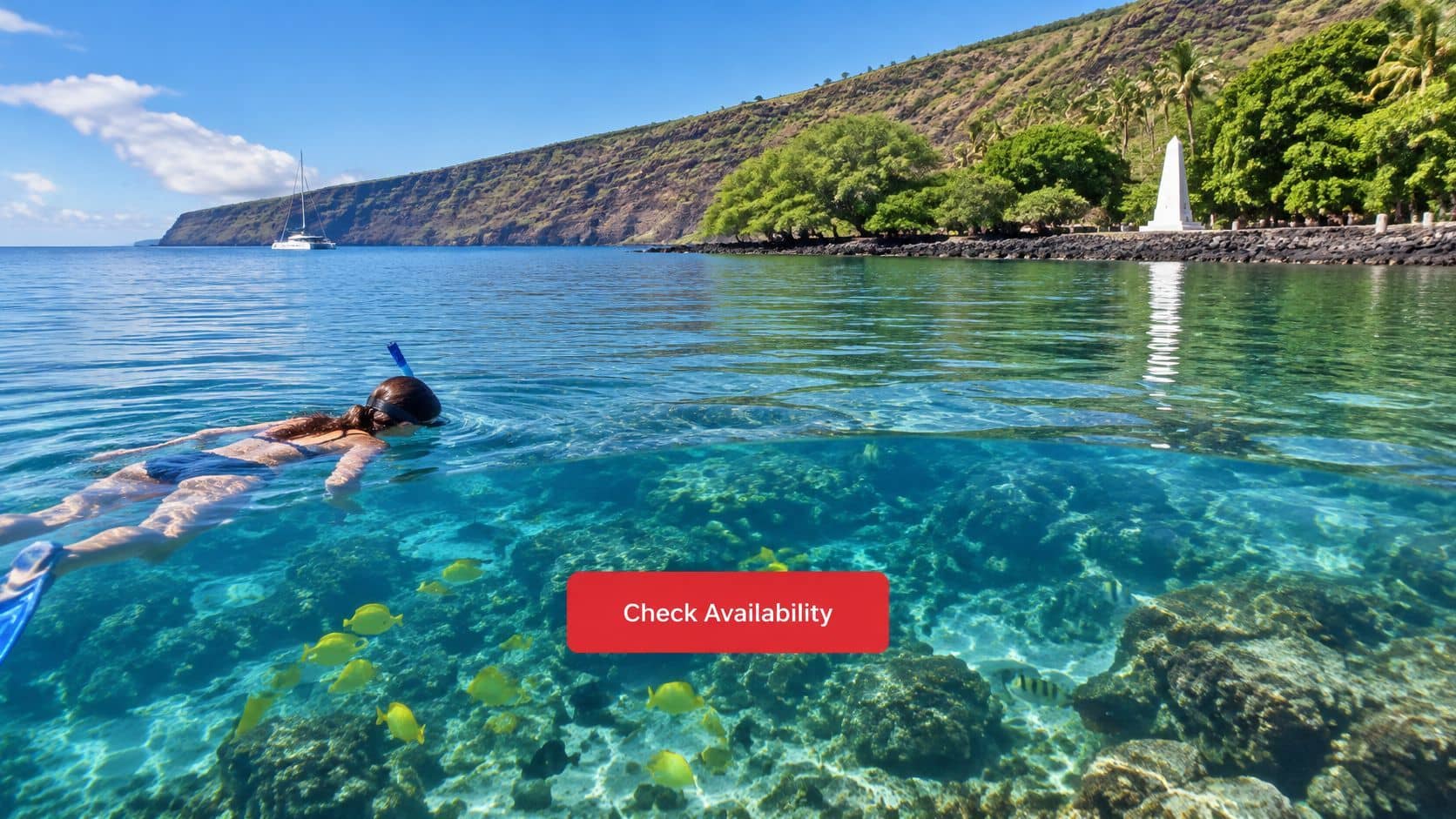
Nobody should expect one uniform reef. The Division of Aquatic Resources page for the Kealakekua Bay Marine Life Conservation District reports abundant coral and marine life in approximately 5 feet of water on the bay's northeastern side, while the area near Nāpōʻopoʻo is generally shallow with limited coral. Farther offshore you'll find encrusting coral, caves, crevices, and ledges to roughly 30 feet, and Kaʻawaloa Cove near the monument provides the greatest depth range, approximately 5 to 120 feet, with exceptional coral and fish diversity.
That range is why guides zone the group by depth. Lifeguard-certified guides swim with guests over the reef, keeping novices in the shallow, structurally complex edge where there's plenty to see without deep water under them. Confident swimmers may fin toward deeper structure only while conditions and the group allow it, and only where the guide can still see them. It's the same cove, used two different ways.
What will you see? Living coral close enough to read, schools of reef fish moving across the slope, and the chance of dolphins on the ride. No specific animal is promised, and any operator who guarantees one is selling you something the ocean hasn't agreed to. The reliable part of this stop is the reef itself. Whether that depth range fits you and your group is the next question, and it's the one to answer clearly.
Who Should Go and How Each Group Spends the Hour
A good fit starts with an honest answer: are you comfortable swimming in deep open water? The crew provides flotation noodles or vests, and lifeguard-certified guides swim with guests, but flotation does not replace swimming ability. A noodle can help a swimmer relax. It cannot make deep water safe for someone who cannot swim.
Non-swimmers can ride the boat and stay aboard. From the deck, they can take in the coastline, the monument from the water, and the bay during the hour-long stop. The boat is a former Navy SEAL boat refitted for snorkelers. Staying aboard is the right choice if entering deep water would leave you struggling.
For practical details on what to bring, see the Kona snorkel-day packing list.
Three Ways Groups Use the Same Hour
A family with a confident child and a cautious parent can stay together over the shallow reef, near a lifeguard-certified guide. Flotation can help the parent relax, while the child gets time to look around without treating deeper water as a goal. Keep the group within the guide's view.
A first-time couple may need a little time to get used to breathing through a snorkel. The guides hand out the gear and show guests how to use it. Once in the water, the couple can stay near the guide and focus on floating and looking rather than kicking far.
A strong swimmer may be comfortable exploring more of the reef, but should follow the guide's directions and return when the crew calls guests aboard. The crew manages the hour; guests should stay within the group and follow its signals.
Each group uses the same hour differently. If you are not comfortable swimming in deep water, stay on the boat rather than relying on flotation to keep you safe.
How to Snorkel the Bay Without Harming It
A good view of wildlife starts with giving it room. A sighting is never guaranteed, and the captain may slow, turn away, or keep the group watching from the boat. That is part of entering a protected bay responsibly.
Hawaiʻi's 2025 Respect Wildlife protocol says vessels must not closely approach, chase, encircle, or trap marine animals. Federal rules prohibit approaching humpback whales within 100 yards and spinner dolphins within 50 yards. They also prohibit feeding spinner dolphins, swimming with them, or actively pursuing them. If dolphins ride the boat's bow wake, watch from aboard and let the captain set the distance.
Rules That Govern Your Hour
- Let the captain judge wildlife distances: Keep at least 100 yards from humpback whales and 50 yards from spinner dolphins. If the boat slows or stops, give the animals space.
- Stay within the swim zone: The snorkel area near Kaʻawaloa Cove is marked to keep powerboats out. A Division of Land and Natural Resources exhibit describes the zone as extending from the shoreline to approximately 100 feet offshore, with buoys or other navigational aids marking it. Stay inside the markers and follow your guide.
- Apply sunscreen before boarding: Choose reef-safe, non-aerosol sunscreen. Applying it on shore helps keep spray away from the boat and water.
- Use gear that fits: The crew provides sanitized masks, snorkels, and fins, checks the fit, and shows guests how to use them. Ask for another size before entering the water.
In the water, keep your fins clear of coral. Don't stand on the reef, touch coral or fish, or chase marine life for a closer look. Leave rocks and cultural sites undisturbed. The background to these protections is explained in why Kealakekua Bay is protected.
The boat tour also avoids the steep, multi-mile hike to the monument, a route with no facilities. That changes how visitors reach the bay, but care in the water still comes down to each person's choices.
Look, float, and let animals choose the distance.
Share that rule with children before they enter. It gives them a simple way to respect the bay while they watch.
Captain Cook Snorkel Tour Questions Answered
What should I wear and bring? Wear swimwear under your clothes and bring a towel, dry clothes, and reef-safe, non-aerosol sunscreen. The crew provides sanitized masks, snorkels, and fins, then checks the fit and shows you how to use them. A hat and sunglasses help at the harbor. Keep valuables simple on a boat, where splashes are part of the ride. For ideas to fill the rest of your Hawaii itinerary, browse holiday inspiration from My Global Trips.
What if I get seasick? If motion bothers you, ask a pharmacist about medicine before the trip. During the boat ride, sit near the middle and look toward the horizon. Eat lightly before boarding, and tell the crew if you start feeling unwell so they can help.
Can I bring my own gear? Call ahead at (808) 480-6611 to ask about personal gear. The tour provides sanitized snorkel gear, and guides help guests use it. If you rely on prescription lenses or a particular mask, check before departure rather than assuming your equipment can be used.
Will I definitely see dolphins or whales? No wildlife sighting is guaranteed. The tour visits Kealakekua Bay to snorkel among coral and fish, with a chance to see dolphins. Treat marine life as a bonus, and follow the crew's directions around animals.
What happens if the weather cancels the trip? Check the booking page's cancellation and change terms before paying. Those terms apply to your date, so read them before you book.
Is the private charter worth it? Choose it if your group wants the boat to itself. The shared Captain Cook Excursion costs $149 per person, lasts 4 hours, and takes up to 18 guests. The Private Captain Cook Excursion costs $1,999 per charter for up to 18 guests on the whole boat, also for 4 hours.
Captain Cook Snorkeling Tours checks in guests at Honokōhau Small Boat Harbor, then takes them to Kealakekua Bay for 1 hour in the water off the Captain Cook Monument. Lifeguard-certified guides swim with guests over the reef, and the crew provides flotation noodles or vests. Check the booking page for departure availability, or contact the business by phone at (808) 480-6611 or email at info@captaincooksnorkelingtours.com.